Buddhists Heritage of Pakistan: A Journey Through Gandhara Civilizations in Pakistan:
When people think about Pakistan, they often picture spectacular mountains, historic Mughal architecture, vibrant cities, and ancient civilizations. Yet Pakistan is also home to one of South Asia’s most fascinating Buddhist legacies.
The Buddhists Heritage of Pakistan: A Journey Through Gandhara Civilization is deeply connected with the ancient region of Gandhara, a historic cultural crossroads that flourished in parts of present-day northern Pakistan and eastern Afghanistan. For centuries, Gandhara was an important center of Buddhist learning, art, architecture, philosophy, and pilgrimage.
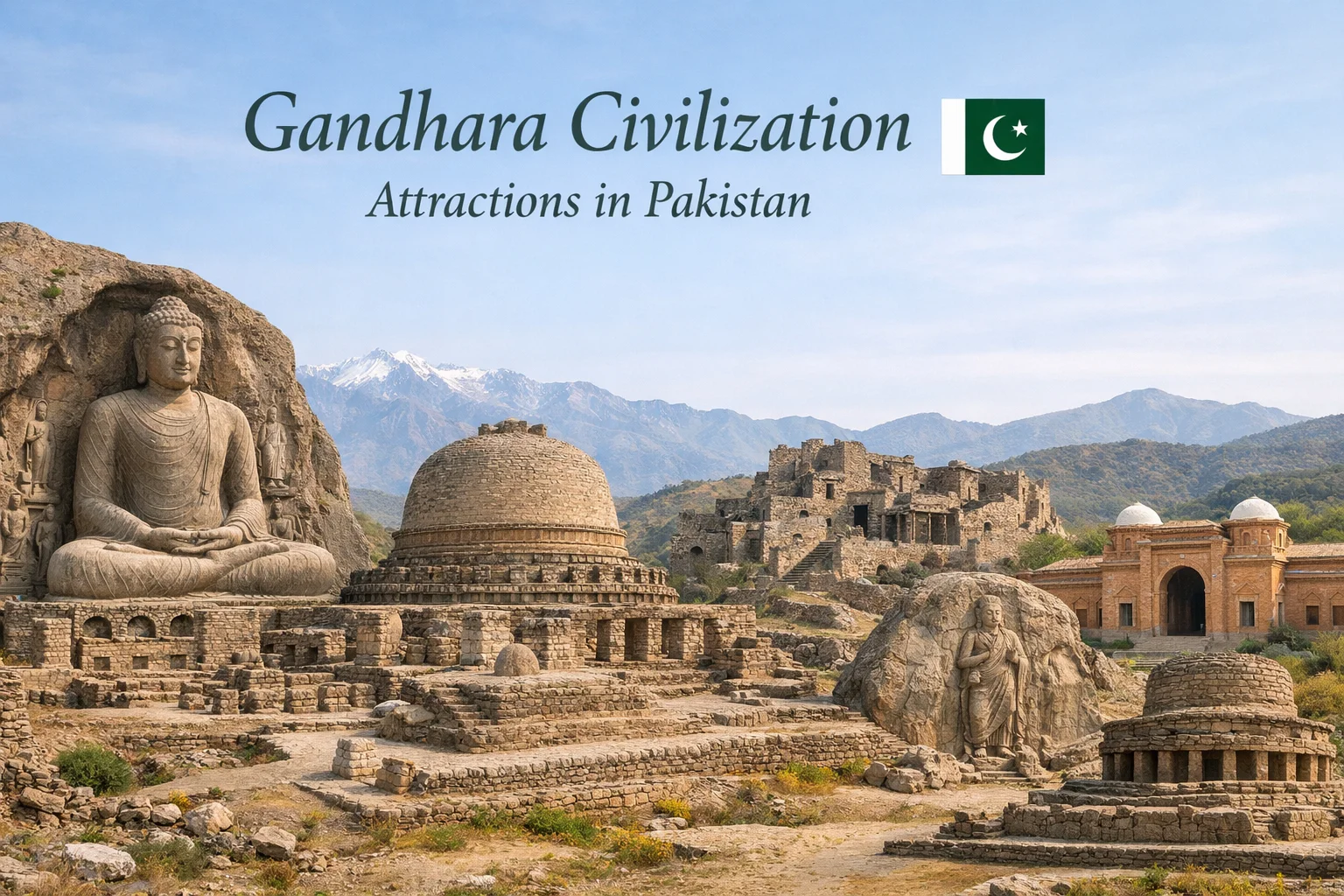
Today, travelers can explore the remains of ancient monasteries, stupas, meditation centers, sculptures, and archaeological sites that reveal the remarkable story of Buddhism in this part of the world. From the archaeological treasures of Taxila to the monasteries of Takht-i-Bahi and the ancient Buddhist sites of Swat Valley, Pakistan offers a unique journey through Buddhist history.
For history enthusiasts, cultural travelers, archaeologists, photographers, and heritage explorers, discovering these sites can add an entirely different dimension to a trip to Pakistan.
What Is Gandhara and Buddhists Heritage of Pakistan: A Journey Through Gandhara Civilization ?
Gandhara was an ancient cultural region located around the Peshawar Valley, Swat Valley, Taxila, and surrounding areas. Its location along important ancient trade routes allowed different civilizations, religions, languages, and artistic traditions to interact.
Gandhara became particularly important for the development and spread of Buddhism. Buddhist monasteries and educational centers were established across the region, attracting monks, scholars, pilgrims, and travelers.
The region is especially famous for Gandharan Buddhist art, which combined local traditions with influences from the wider Hellenistic world. One of its most recognizable achievements was the development of realistic representations of the Buddha in human form.
This artistic tradition eventually influenced Buddhist art far beyond Gandhara, contributing to the visual development of Buddhism across Central and East Asia.
A Brief History of Buddhists Heritage of Pakistan: A Journey Through Gandhara Civilization and Buddhism.
Buddhists Heritage of Pakistan: A Journey Through Gandhara Civilization firmly established in the ancient Gandhara region following the expansion of the Mauryan Empire.
The Mauryan emperor Ashoka, traditionally associated with the spread of Buddhism across South Asia, played an important role in the religion’s history. Buddhist traditions connect Ashoka with the construction and patronage of stupas and monasteries throughout his empire.
Over subsequent centuries, Gandhara developed into a major center of Buddhist culture.
The region experienced the influence of several powerful dynasties, including the Indo-Greek, Kushan, and later ruling traditions. Under the Kushans, particularly during the reign of Kanishka, Buddhist institutions and Gandharan art experienced significant development.
Monasteries became centers of education and religious life, while artists produced sculptures depicting the Buddha, Bodhisattvas, and scenes from Buddhist traditions.
Chinese Buddhist pilgrims later traveled through the region, documenting monasteries, cities, and religious communities. Their accounts provide valuable evidence about the importance of Gandhara as a Buddhist center.
Taxila: One of Pakistan’s Most Important Buddhists Heritage of Pakistan: A Journey Through Gandhara Civilization
Taxila is one of the most important archaeological destinations for anyone interested in the Buddhists Heritage of Pakistan: A Journey Through Gandhara Civilization Buddhist heritage of Pakistan.
Located in Punjab, approximately 30 kilometers northwest of Islamabad, Taxila developed as an important center of learning and commerce. Its strategic position connected it with routes leading toward Central Asia, South Asia, and other parts of the ancient world.
The archaeological remains around Taxila include ancient cities, monasteries, stupas, and religious complexes.
Dharmarajika Stupa |Buddhists Heritage of Pakistan: A Journey Through Gandhara Civilization
The Dharmarajika Stupa is among the most significant Buddhist monuments in the Taxila region.
The large stupa complex was surrounded by smaller stupas and monastic structures. Its development is associated with the early centuries of Buddhism in the region and reflects the importance of Taxila as a religious center.
Visitors interested in archaeology can explore the remains and imagine the religious activity that once surrounded this important monument.
Jaulian Buddhist Monastery
The Jaulian Buddhist Monastery is another remarkable site near Taxila.
Situated on a hill, the monastery contains the remains of monastic cells, stupas, and beautifully preserved Buddhist sculptures. The location also provides views over the surrounding landscape.
Jaulian offers travelers an opportunity to see how Buddhist monks lived, studied, and practiced in ancient Gandhara.
Takht-i-Bahi: A Remarkable Buddhist Monastic Complex
Takht-i-Bahi is one of the best-preserved Buddhist monastic complexes in Pakistan.
Located near Mardan in Khyber Pakhtunkhwa, Takht-i-Bahi occupies a dramatic hilltop location. The site’s name is often translated as the “Throne of the Spring.”
The complex includes courtyards, meditation cells, assembly areas, stupas, and other structures associated with Buddhist monastic life.
Its elevated position helped protect the monastery from flooding and provided a peaceful environment for religious practice.
Takht-i-Bahi is particularly valuable because much of its architectural layout remains visible. Walking through its ancient passages and courtyards provides a strong sense of the organization of Buddhist monastic communities in Gandhara.
The archaeological site is recognized as a UNESCO World Heritage Site, making it an essential destination for travelers exploring Pakistan’s ancient history.
Buddhist Heritage of Swat Valley | Buddhists Heritage of Pakistan: A Journey Through Gandhara Civilization
The Swat Valley is another extraordinary destination for exploring Buddhist heritage in Pakistan.
Today, Swat is famous for its green mountains, rivers, forests, and spectacular scenery. But the valley was also an important center of Buddhism in ancient Gandhara.
Archaeological discoveries throughout Swat have revealed numerous monasteries, stupas, sculptures, and other Buddhist remains.
Butkara Stupa
Butkara Stupa is one of the best-known Buddhist monuments in Swat.
Located near Mingora, the stupa complex developed over several centuries. Archaeological excavations have uncovered multiple construction phases, demonstrating the long religious history of the site.
Butkara is particularly interesting for visitors because it illustrates how Buddhist monuments evolved over time.
Udegram Buddhist Monastery
The archaeological remains at Udegram provide further evidence of the importance of Buddhism in ancient Swat.
The area contains remains associated with Buddhist religious activity and reflects the valley’s role as a center of culture and pilgrimage.
Exploring these sites alongside Swat’s spectacular natural scenery makes the valley especially appealing to travelers interested in combining heritage tourism and nature travel.
Gandharan Buddhist Art
One of the greatest treasures of Pakistan’s Buddhist heritage is its ancient sculpture.
Gandharan art is famous for its distinctive style, which combines Buddhist themes with artistic influences associated with the Hellenistic world.
Many Gandharan sculptures depict the Buddha wearing flowing robes, with carefully carved facial features and realistic human proportions.
Other sculptures portray Bodhisattvas, Buddhist stories, celestial figures, and scenes from the Buddha’s life.
Why Is Gandharan Art Important? Buddhists Heritage of Pakistan: A Journey Through Gandhara Civilization
Gandharan art is historically significant because it represents a remarkable meeting of cultures.
Greek artistic traditions, local South Asian traditions, Central Asian influences, and Buddhist religious themes came together in a distinctive visual language.
The artistic legacy of Gandhara subsequently influenced Buddhist communities and artistic traditions across Asia.
For visitors, museums in Pakistan provide an opportunity to see examples of this extraordinary heritage.
Peshawar and the Gandhara Region
Peshawar has played an important role in the history of Gandhara.
The ancient Peshawar Valley was a major cultural and commercial center, and the surrounding region contains numerous archaeological remains associated with Buddhism.
The Peshawar Museum is particularly important for travelers interested in Gandharan civilization. Its collections include Buddhist sculptures and archaeological artifacts that help explain the artistic and religious history of ancient Gandhara.
A visit to the museum can be an excellent complement to exploring archaeological sites outside the city.
Buddhist Sites in Khyber Pakhtunkhwa
Khyber Pakhtunkhwa contains some of the richest concentrations of Buddhist archaeological remains in Pakistan.
Beyond Takht-i-Bahi and Swat, archaeological discoveries have been made in areas including Mardan, Peshawar, Buner, Dir, and other parts of the former Gandhara region.
These remains demonstrate that Buddhism was not confined to a single city or monastery. Instead, religious networks connected communities across valleys, trade routes, and settlements.
For heritage travelers, this makes Khyber Pakhtunkhwa an especially important region to explore.
The Role of Ancient Trade Routes
The development of Buddhism in Gandhara was closely connected with ancient trade.
Gandhara occupied a strategic location between South Asia, Central Asia, and regions farther west. Merchants, pilgrims, monks, scholars, and travelers moved through these routes.
Monasteries were often established near important roads and settlements, allowing religious communities to interact with travelers and merchants.
These connections helped ideas, artistic styles, languages, and religious traditions travel across Asia.
In this sense, Gandhara was not isolated. It was part of a much larger network connecting different civilizations.
Buddhist Pilgrims and Chinese Travelers
Ancient Chinese Buddhist travelers played an important role in documenting Gandhara.
Travelers such as Faxian and Xuanzang journeyed through parts of the region and recorded information about Buddhist monasteries, sacred places, cities, and religious communities.
Their accounts are valuable historical sources because they provide descriptions of places and traditions that can be compared with archaeological evidence.
Xuanzang’s travels in particular provide an important window into the Buddhist landscape of the region during the seventh century.
Why Visit Pakistan’s Buddhist Heritage Today?
Exploring Buddhist heritage in Pakistan offers much more than visiting archaeological ruins.
It provides an opportunity to understand how cultures interacted across ancient Asia.
1. Experience Ancient History
Pakistan’s archaeological sites connect modern travelers with civilizations that flourished thousands of years ago.
2. Discover Gandharan Art
Visitors can learn about a unique artistic tradition that influenced Buddhist art across Asia.
3. Combine Heritage With Nature
Many Buddhist archaeological sites are located amid spectacular landscapes, particularly in Swat and northern Khyber Pakhtunkhwa.
4. Explore a Lesser-Known Side of Pakistan
Many international visitors know Pakistan for the Karakoram mountains and Hunza Valley. Fewer realize that the country also contains extraordinary Buddhist archaeological heritage.
5. Understand Cultural Connections
The story of Gandhara demonstrates how trade, migration, religion, and artistic exchange shaped Asian history.
Best Time to Explore Buddhist Heritage in Pakistan
The best time to visit depends on the region.
For Taxila and Punjab, spring and autumn generally offer comfortable conditions for sightseeing.
For Swat and other mountainous areas of Khyber Pakhtunkhwa, spring, summer, and autumn can provide excellent opportunities for exploration, although conditions vary by elevation and location.
Before traveling, visitors should check current local conditions, access restrictions, road conditions, and official travel guidance.
How to Plan a Buddhist Heritage Tour in Pakistan
A heritage-focused Pakistan itinerary can combine several important destinations.
A possible route could include:
Islamabad → Taxila → Peshawar/Mardan → Takht-i-Bahi → Swat Valley
This journey combines archaeological sites, museums, historic landscapes, and mountain scenery.
Travelers with additional time can explore further archaeological locations in the Gandhara region.
Because some archaeological sites are remote or have limited visitor infrastructure, traveling with a knowledgeable local guide can make the experience considerably more informative.
Responsible Heritage Tourism
Pakistan’s Buddhist archaeological sites are irreplaceable cultural treasures.
Visitors should avoid touching sculptures or archaeological remains, climbing monuments, removing stones or artifacts, or disturbing excavation areas.
Photography should follow site regulations, and travelers should respect local communities and religious sensitivities.
Responsible tourism helps ensure that these remarkable sites can be protected for future generations.
Frequently Asked Questions About Buddhists Heritage of Pakistan: A Journey Through Gandhara Civilization
The most important Buddhist archaeological heritage is concentrated in regions historically associated with Gandhara, including Taxila, Khyber Pakhtunkhwa, Swat Valley, Peshawar, Mardan, and surrounding areas.
What is Gandhara famous for?
Gandhara is famous for its Buddhist civilization, monasteries, stupas, and especially Gandharan Buddhist art, which reflects a fascinating mixture of South Asian and Hellenistic artistic influences.
Is Taxila a Buddhist site?
Taxila was a major ancient center of learning and culture with numerous Buddhist monasteries and stupas. The archaeological remains around Taxila are among Pakistan’s most important heritage attractions.
What is Takht-i-Bahi famous for? Buddhists Heritage of Pakistan: A Journey Through Gandhara Civilization
Takht-i-Bahi is famous for its exceptionally well-preserved Buddhist monastic complex and is recognized as a UNESCO World Heritage Site.
Can tourists visit Buddhist archaeological sites in Pakistan?
Many important archaeological sites are open to visitors, but access and conditions can vary. Travelers should verify current opening arrangements, local conditions, and any applicable travel restrictions before visiting.
Conclusion: Discover the Forgotten Buddhist Legacy of Pakistan
The Buddhists Heritage of Pakistan: A Journey Through Gandhara Civilization is one of the country’s most remarkable yet underappreciated cultural treasures.
From the ancient cities and monasteries of Taxila to the hilltop complex of Takht-i-Bahi and the Buddhist remains scattered throughout Swat Valley, the archaeological landscape of Pakistan tells the story of a civilization that connected South Asia with Central Asia and the wider Buddhist world.
Gandhara’s importance goes beyond its ruins. Its art, monasteries, trade routes, and intellectual traditions demonstrate how different cultures met and influenced one another.
For travelers looking for something beyond conventional sightseeing, exploring Pakistan’s Buddhist heritage offers an unforgettable journey through history.
Plan your Pakistan heritage adventure with Incredible Pakistan and discover the ancient stories, remarkable landscapes, and cultural treasures that make Pakistan truly incredible.